416-301-0088


By the Sagecare care team | Medically reviewed by Navkiran Dhesi, RN, Sagecare | Last updated September 25, 2026
Vascular Dementia At a Glance
● Vascular dementia is a decline in thinking caused by damage to the blood vessels that feed the brain, most often from a stroke or a series of small, silent strokes.
● The first changes are usually in planning, judgment and walking rather than memory, which is why families often miss it or assume it’s Alzheimer’s.
● It tends to move in steps: a sudden drop, then a plateau that can last months or years, then another drop after the next vascular event.
● There’s no single test and no medication that reverses the damage, so care focuses on protecting the blood vessels and keeping daily life steady and safe.
● Many people have vascular changes and Alzheimer’s at the same time, and the care they need is much the same.
Vascular dementia is a decline in memory, thinking and judgment caused by conditions that block or reduce the flow of blood to the brain. When brain cells lose their blood supply, they lose oxygen and die, and the abilities those cells supported go with them.
It’s the second most common type of dementia after Alzheimer’s disease, yet most families have never heard the term until a doctor says it out loud. That first appointment tends to raise more questions than it answers, starting with whether this is the same as Alzheimer’s, whether it will get worse quickly and what the family should do now.
Many of the families who come to our home arrive at exactly this point, and we hold to something simple: people are more than their medical conditions, and it is easier to face the unknown with someone you trust. Understanding the condition is what turns fear into a plan. Here’s what vascular dementia is, what it looks like at home and how it differs from the dementia most people already know about. If you’d like to learn about dementia and Alzheimer’s more broadly, that page is a good companion to this one.
What Vascular Dementia Is and What Causes It
The brain depends on a constant supply of oxygen-rich blood. Vascular dementia happens when that supply is interrupted, and the interruption can come in two very different ways.
The first is a stroke. According to the Alzheimer Society of Canada, having a stroke more than doubles the risk of developing dementia, because the blocked or burst artery starves a region of the brain in one event. Some strokes are large and obvious, while others, which the Society calls covert strokes, block a small vessel silently, with no symptoms anyone would notice at the time.
The second path is slower. Over years, the smallest blood vessels in the brain can stiffen and narrow, a condition doctors call small vessel disease. Blood still gets through, but less of it, and the brain tissue that depends on those vessels gradually loses ground.
The risk factors are the ones a family doctor already tracks: high blood pressure, diabetes, high cholesterol, atrial fibrillation, smoking and physical inactivity. The Alzheimer Society names high blood pressure as the single most important risk factor, and researchers estimate that vascular dementia accounts for 15 to 25 percent of all dementia cases.
The Early Signs Families Notice First
With Alzheimer’s, memory usually slips first, but with vascular dementia the first changes often show up somewhere else, and that difference confuses a lot of families.
The Alzheimer Society describes the earliest symptoms as changes in the ability to make decisions, plan or organize. A parent who always handled the bills starts leaving them unopened, or a simple errand with three stops becomes overwhelming. Thinking slows down, and conversations take longer to follow. One daughter on a caregiver forum described her mother’s decline as a loss of logic rather than memory, and that phrase captures it well.
Movement changes early too. The Society lists slow walking and poor balance among the first signs, because the parts of the brain that manage gait are often affected by the same reduced blood flow. Families may notice shuffling steps, a hand that now reaches for the wall in the hallway, more stumbles or a new reluctance to use the stairs up to the bedroom.
Mood can shift as well, so someone who was steady may become tearful, irritable or flat, sometimes within the same afternoon. Because these signs don’t look like the forgetfulness most people associate with dementia, they’re often put down to aging, stress or a bad week. If several of them appear together, or appear suddenly after a hospital stay, it’s worth raising with a doctor, and an early diagnosis gives a family more time to plan.
One distinction matters more than any other. A sudden change, such as a face that droops on one side, an arm that suddenly feels weak, or speech that becomes slurred or jumbled, is not a symptom to watch and wait on. It may be a stroke happening now. Learn the FAST signs of stroke from Heart & Stroke, and call 9-1-1 right away if you see them.
How Vascular Dementia Progresses: In Steps, Not a Slope
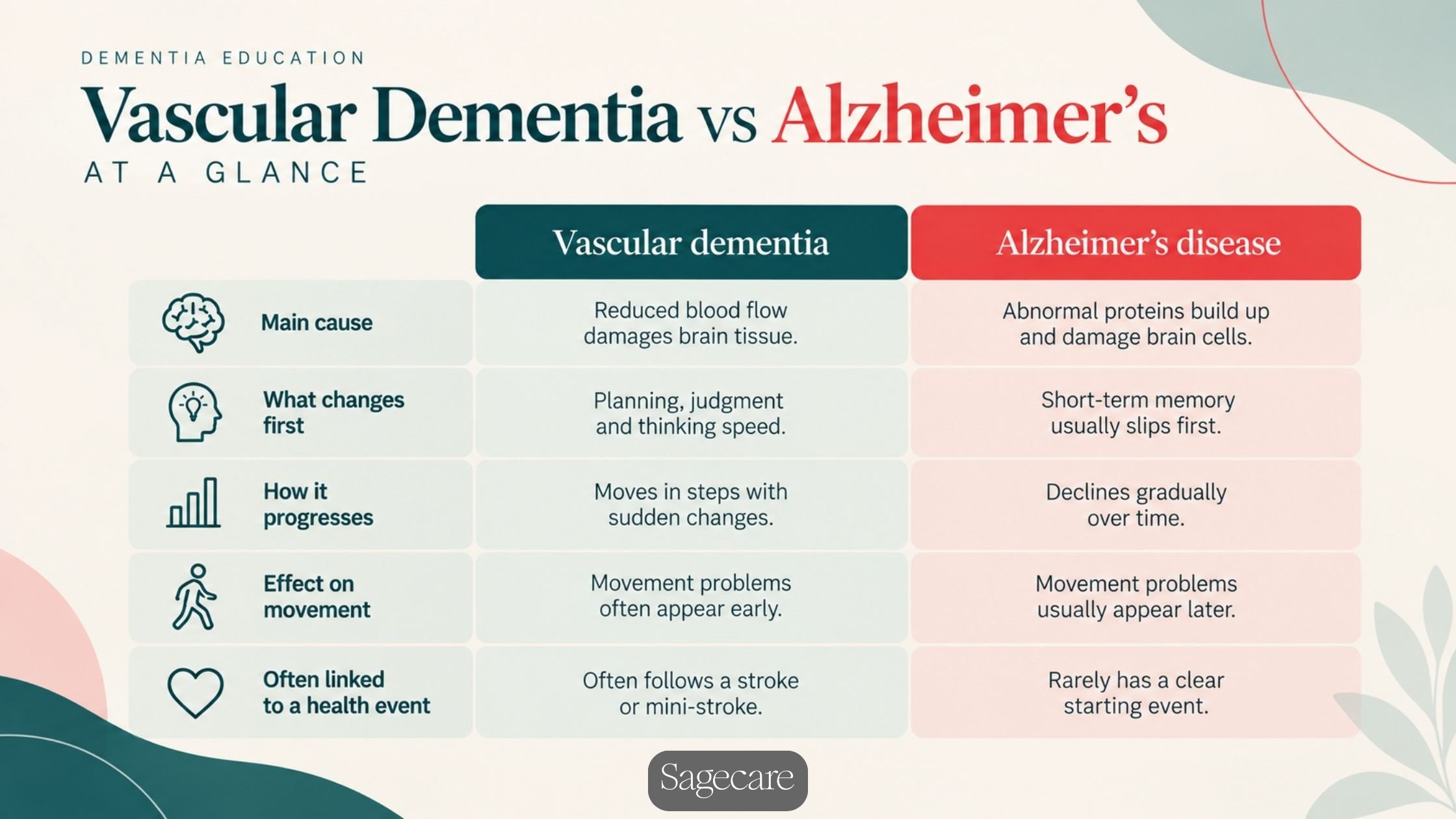
The most distinctive thing about vascular dementia is the shape of its progression. The Alzheimer Society puts it plainly: abilities deteriorate, stabilize for a time and then decline again, which is why families so often describe it as steps.
A parent has a small stroke and loses ground over a few days. Then nothing much changes for six months, or a year, or longer. Then another vascular event, and another step down. On caregiver forums, one family member wrote that after each dip her mother-in-law improved quite a bit, not to where she had been before, but close. That recovery after a drop is real, and it’s one of the reasons this condition can feel so unpredictable.
Doctors and care teams often talk about three broad stages, though the Heart and Stroke Foundation is careful to note that symptoms depend on which parts of the brain are affected and that each person’s path is different.
● In the early stage, the person manages most of daily life but struggles with planning, multitasking, money and concentration, and may walk more slowly.
● In the middle stage, confusion becomes more frequent, language and judgment are affected and help is needed with medications, meals and getting around safely.
● In the late stage, the person needs support with nearly every daily task, including eating, dressing and moving, and may not recognize familiar people.
How long each stage lasts varies enormously, and no one can predict when the next step will come. That’s quite different from the gradual slope described in the 7 stages of Alzheimer’s. What families can influence is how well the blood vessels are protected between steps, and how steady and safe daily life is in the meantime.
Vascular Dementia vs Alzheimer’s: What Is Actually Different
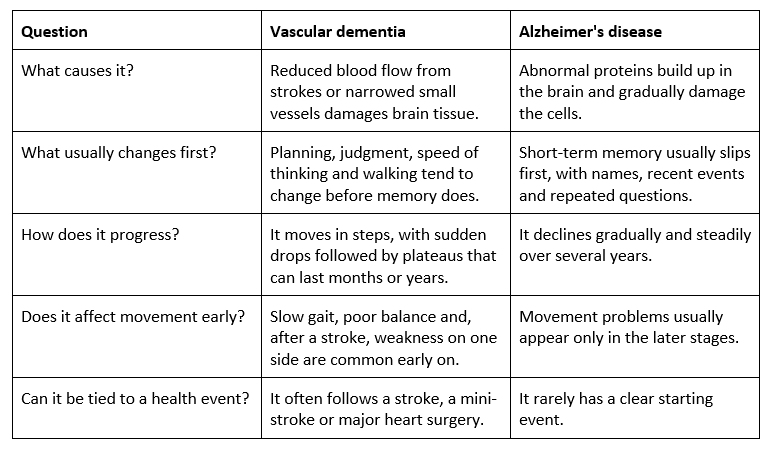
The Heart and Stroke Foundation says it directly: vascular dementia and Alzheimer’s disease share similar signs and symptoms, but they are not the same disease. The table below sets out the differences families ask about most.
There’s an important catch, though. The Alzheimer’s Association estimates that only 5 to 10 percent of people with dementia have vascular dementia alone, and that it’s more common as part of mixed dementia.
The Alzheimer Society of Canada says the usual combination is Alzheimer’s plus vascular dementia, and that autopsy studies suggest mixed dementia is much more common than doctors once realized.
So the honest answer to “which one does Mom have?” is often “some of both.” Knowing the different types of dementia helps families understand what they’re seeing, and it’s worth remembering that other types, such as Lewy body dementia, can look similar from the outside as well.
How Doctors Diagnose Vascular Dementia
There’s no single test for vascular dementia. The Alzheimer Society explains that doctors combine a physical exam, including blood pressure and cholesterol, with cognitive testing of judgment and planning and a detailed medical history.
Brain imaging usually completes the picture. The Alzheimer’s Association notes that a diagnosis rests on cognitive testing that confirms impairment, an MRI or similar scan that shows a stroke or compatible vascular changes, and no other condition that explains the symptoms.
For families, the practical part is the history. Write down when the changes started, whether they came on suddenly, whether there was a fall, a hospital stay or a heart procedure around that time, and what the person can no longer do that they could do six months ago. That timeline is often the most useful thing you can bring to the appointment.
What Treatment and Daily Care Look Like
Families usually want to know whether vascular dementia can be reversed. The Alzheimer Society is clear that there are currently no medications that can reverse the brain damage it causes. The Alzheimer’s Association adds that medications approved for Alzheimer’s have shown only modest benefit for vascular dementia.
What treatment does is protect what remains. Controlling blood pressure, blood sugar and cholesterol, treating an irregular heartbeat and stopping smoking all reduce the chance of another stroke, which is the main thing that drives the next step down.
The Alzheimer’s Association says that managing these risk factors may help postpone or prevent further decline. Day to day, care for vascular dementia looks much like care for any dementia, with a few extra points of attention.
● A steady routine reduces the mental effort of each day, which matters more when thinking has slowed. We explain why routine matters in more depth elsewhere.
● Hydration and regular meals support blood pressure and help prevent the sudden confusion that dehydration and infection can trigger.
● Walking support, good lighting and clear floors address the balance problems that appear early in this condition, and regular fall safety checks keep the home one step ahead of them.
● Nursing oversight catches the small changes, in speech, strength or alertness, that can signal a new vascular event.
This is the kind of daily attention that personalized memory care for elders is built around. We observe, and we slow down. Because our nurses know each elder well, a change in speech, strength or balance is noticed the day it happens and treated as something to understand, never as a box to tick.

When a Family Should Reach Out for More Support
Because vascular dementia moves in steps, the moment to ask for help often arrives suddenly. A parent who was managing at home in March may not be safe there in April after a small stroke.
Watch for missed medications, falls or new bruises, meals that go uneaten, a stove left on, or a parent who gets lost on a familiar route. Our guide to the signs a loved one is no longer safe living alone walks through these in detail. The pattern matters more than any single incident, and after a step down it’s worth reassessing honestly before the next one arrives.
Asking for help at that point is not giving up on a parent. It is one way of protecting the sanctity of their home, wherever that home turns out to be, and it is easier to face the unknown with someone you trust.
Frequently Asked Questions
What are the 3 stages of vascular dementia?
Most care teams describe three: early, middle and late. Early on, a person usually still lives much as before but finds planning, money and concentration harder and may walk more slowly. In the middle stage, they need a hand with medications, meals and getting around safely. Late in the condition, they need support with almost everything. Because vascular dementia moves in steps, think of these stages as a rough map rather than a schedule.
Is vascular dementia hereditary?
In most cases, no. Vascular dementia itself isn’t usually inherited, but the health conditions that lead to it, such as high blood pressure, diabetes, high cholesterol and heart disease, often run in families. Rare genetic conditions such as CADASIL are the exception. For adult children, the most useful response is practical: know your own numbers, especially blood pressure, and work with your doctor to keep them in a healthy range.
Can vascular dementia be reversed?
The damage already done can’t be undone, but that isn’t the whole story. Treatment aims to prevent the next stroke, and good control of blood pressure, blood sugar and cholesterol, along with treating an irregular heartbeat and quitting smoking, gives a person the best chance of staying on a plateau longer. Many families also see some recovery in the weeks after a vascular event, even if it doesn’t bring a person all the way back to where they were.
How fast does vascular dementia progress?
There’s no reliable answer for an individual, because vascular dementia progresses in steps, and the pace depends largely on whether and when further strokes occur. Some people remain stable for years after a diagnosis, while others decline more quickly after a series of vascular events. Protecting the blood vessels slows the pace for many people. A doctor who knows the person’s heart and stroke history can give a more useful picture than any general average found online.
What is the life expectancy with vascular dementia?
It varies widely from person to person. The Alzheimer’s Society in the UK gives an average of around five years from when symptoms begin, and many people live longer, but an average says very little about any one individual. Much depends on overall heart health and whether further strokes occur, which is why steady management of blood pressure and other risk factors matters at every stage. A doctor who knows the person’s history is the best source of a realistic picture, and whatever the timeline, the goal is for that time to be comfortable, connected and lived with dignity.
Does vascular dementia cause anger or excessive sleeping?
It can, because damage to the parts of the brain that regulate emotion can bring irritability, tearfulness or anger that seems out of character, and slowed thinking often comes with more daytime sleepiness. A sudden change in either, especially over a day or two, should be checked by a doctor, because it can also signal a new stroke, an infection or dehydration, none of which is the dementia itself. Calm routines, good lighting and enough rest help with both.
How Sagecare Supports Residents Living With Vascular Dementia
A diagnosis of vascular dementia changes what a family watches for, and it changes what good care looks like. Steady routines, careful attention to blood pressure and hydration, support for walking and balance, and nurses who notice when something shifts are the everyday tools that keep a person comfortable between steps. Cognitive abilities may change, but human needs do not.
At Sagecare, elders living with vascular dementia, Alzheimer’s or mixed dementia live in a home-like setting on Elder Street in North York, where every member of our community is well-known, honoured, respected and loved. Our registered nurses and care specialists come to know each resident like family, and our high staff-to-resident ratio means there is always time to notice the day something changes. Home is a sacred place, and we protect it.
If your family has just heard the words vascular dementia and isn’t sure what comes next, talk with our care team. We’ll answer any question, and when you’re ready, you can book a tour of Sagecare on Elder Street. There’s no rush, and there’s no wrong question.